
Train seniors in companies: VR and AI avatars to restore desire and boost skills
- Christèle Simeoni
- Jan 8
- 5 min read

Senior training enterprise: VR and AI to increase skills.
Aging does not mean giving up on learning, nor losing one’s curiosity. On the contrary. In a rapidly changing world, many seniors express a strong desire to understand, to stay connected to others and to continue to feel useful and involved in their journey.
However, senior learning is still too often addressed with formats that are not adapted, sometimes infantilising, sometimes too technical, and often disconnected from the real experience of the learners.
At VRAI Learning, we are convinced that it is not age that hinders learning, but the way in which it is proposed.
Seniors and training: a dynamic in full evolution
The figures show a contrasting reality. In Europe, the share of people over 60 years old continues to increase and will represent nearly a third of the population by 2050. In France, a majority of seniors now use the Internet regularly, exchange information and consume digital content.
Yet only a minority participate in structured training courses after 60 years. Not because of a lack of desire, but because of the lack of reassuring, engaging and truly designed formats for them.
The fear of "not being up to the task", the feeling that digital technology is "no longer for them", or even overly theoretical and top-down experiences create a gradual disconnection. The challenge is therefore not to simplify the content, but to transform the experience.
The limits of classical educational formats
Traditional approaches to training still rely heavily on top-down transmission of knowledge. Long presentations, static e-learning modules, complex interfaces: so many elements that can generate cognitive fatigue, loss of attention and discouragement.
Among seniors, these limits are often amplified by a lack of human interaction and by the difficulty in projecting oneself into abstract situations. Learning then becomes a constraint, where it could be a moment of discovery and pleasure.



Virtual reality: learning through lived experience
Virtual reality profoundly changes the way of learning. It does not require imagining a situation: it allows one to experience it.
Immersed in an immersive environment, the learner explores, observes, acts and understands through experience. Studies show that immersive learning significantly improves memorization and engagement, with knowledge retention much higher than traditional formats.
For seniors, VR offers a particularly reassuring framework. The error is no longer visible, the gaze of others disappears, and each person moves at their own pace. Learning becomes concrete, embodied and progressive again.

Conversational AI avatars: putting humans back into digital
If immersive technology is a powerful lever, it takes all its value when accompanied. This is where conversational AI avatars come in.
An avatar is not simply a technical guide. It embodies a presence, creates a dialogue and establishes a relationship. It explains, reformulates, encourages and adapts to the learner’s reactions.
Our avatars are designed as true learning companions. They reduce the feeling of loneliness often associated with digital and give a human dimension to training. Thanks to artificial intelligence, the experience becomes personalized. The pace, language level, and scenarios adjust in real time. The learner no longer has to adapt to the device: it is the device that adapts to him.
Immersive journeys at the service of everyday life
The uses of immersive learning for seniors are numerous and deeply concrete. Health prevention, daily safety, cultural discovery, understanding digital services, maintaining cognitive abilities or even transmitting knowledge: the courses can cover real and useful life situations.
In these experiments, the avatar plays a central role. It reassures, guides and accompanies, creating a link that transforms learning into a lived experience rather than simply acquiring knowledge.
Benefits that go beyond training
The feedback observed on immersive courses shows effects that go far beyond learning itself. Seniors gain confidence, regain the pleasure of learning and feel valued in their ability to understand and evolve.
Immersion and interaction also contribute to fighting against the feeling of isolation, by recreating a form of presence and dialogue. Learning then becomes a positive, stimulating and social moment.
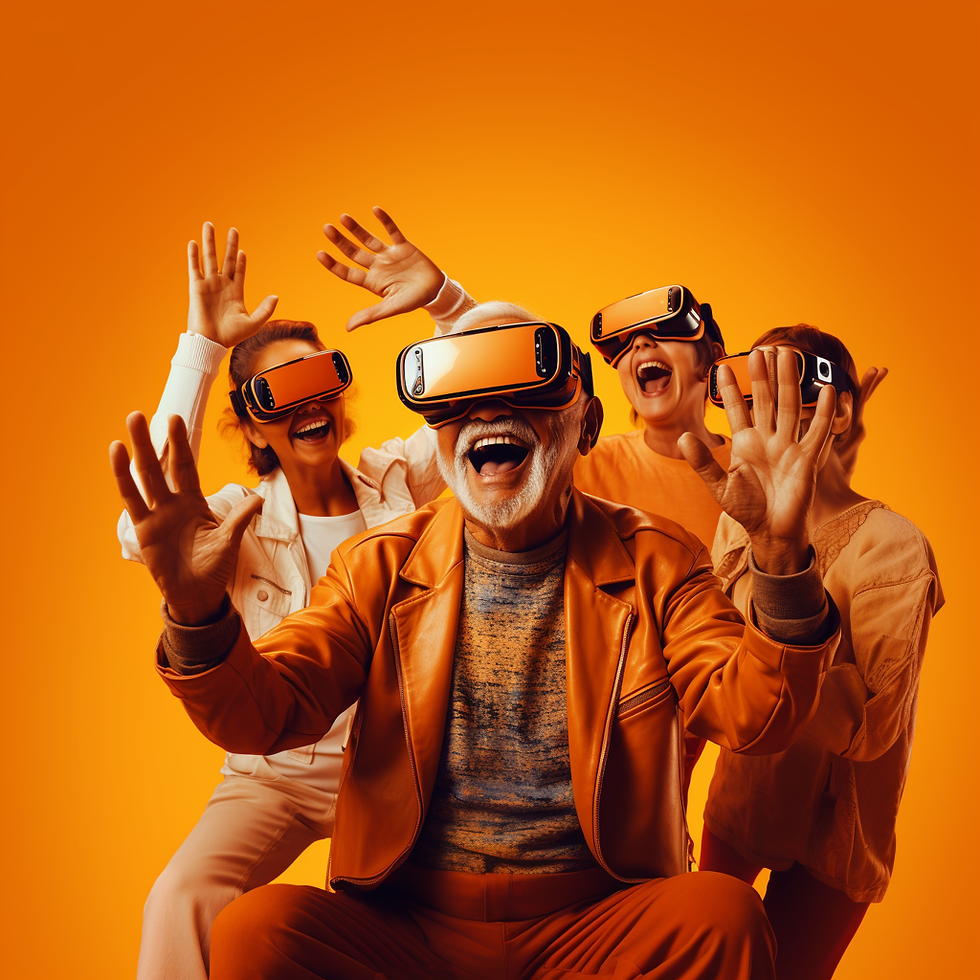
An inclusive vision of innovation
Training seniors is not a secondary topic. It is a central issue for building a more inclusive society, where everyone can continue to learn throughout their lives.
Technology, when thought right, becomes a formidable tool for inclusion. Provided that human experience is placed at the heart of design.
It is this vision that we carry at VRAI Learning: designing immersive experiences with conversational AI avatars that adapt to audiences, and not the other way around.
All students, all mentors: learning beyond generations
Senior learning is at a turning point. Virtual reality and conversational avatars pave the way for more engaging, more humane and above all, more accessible journeys.
Training seniors is not just about giving them technical tools; it’s about creating a space where experiences meet. Through immersion, learning becomes a real dialogue. We are no longer satisfied with "forming an age category": we allow everyone, regardless of their background, to remain active in the world, to share their skills and to learn from those of others.
Technology should not be a barrier, but the bridge that connects our knowledge!
Do we talk about it?
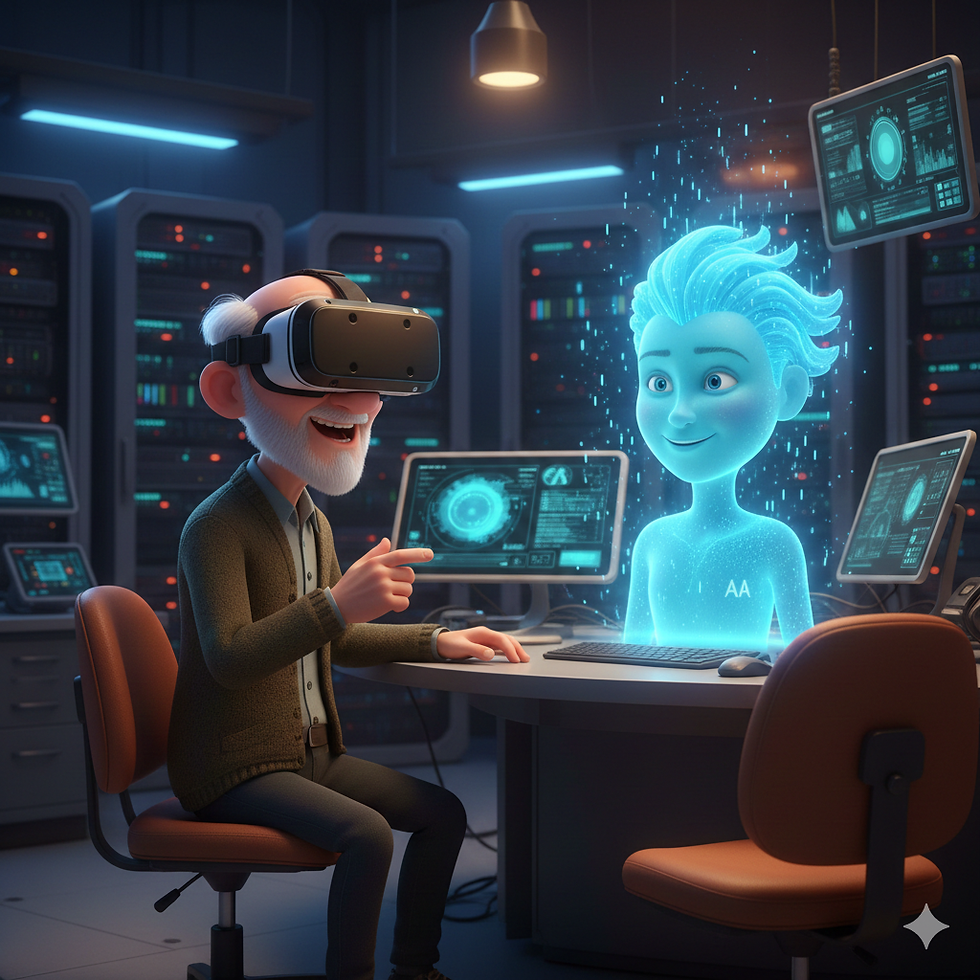
**Des chiffres en bonus (source Chatgpt!)
📍 Participation des seniors à la formation en entreprise (données internationales)
👉 Selon l’OCDE, la participation à l’apprentissage des adultes diminue avec l’âge :
seulement 31 % des 60-65 ans ont déclaré suivre une formation (formelle ou non) au cours de l’année, contre plus de 50 % des 25-44 ans. OECD
dans les pays de l’OCDE, en moyenne 35 % des travailleurs de 55-64 ans ont participé à une formation dans les 12 derniers mois, contre 48 % pour les 35-54 ans. OECD
🔹 Dans les pays de l’OCDE, seulement environ 24 % des travailleurs âgés de 55 à 65 ans participent à des formations liées à l’emploi, contre 41 % des 45-54 ans. Cela signifie que, malgré une envie d’apprendre, les seniors reçoivent moins de soutien formation de la part de leurs employeurs que les générations plus jeunes. OECD
🔹 Au niveau européen, environ 35 % des 55-64 ans ont déclaré avoir suivi une formation ou une activité éducative au cours des 12 derniers mois, contre près de 47 % des 25-64 ans — ce qui traduit un écart important dans l’inclusion des seniors dans les stratégies de développement des compétences des entreprises.
📌 Les pays nordiques comme Norvège, Finlande et Danemark affichent des taux de participation à la formation pour les 55-65 ans proches de 50 %, bien supérieurs à la moyenne européenne de ~32 %. euronews
👉 Ces chiffres montrent que le vieillissement de la population ne signifie pas une fin de l’apprentissage, mais plutôt un besoin d’adapter les formats pour répondre à une participation encore trop faible chez les seniors dans de nombreux pays. ?


